Showing posts with label air conditioning. Show all posts

Thursday, May 14, 2015

Rooftop Air Conditioner on Condo


On one of the few rainy days we have here in Los Angeles and we had a packaged Heating and Air Conditioning unit to install on a the roof of a 4 story condominium. 
The guys worked hard in a tricky situation. See the high voltage electrical line coming from the utility pole and hanging across the roof? The crane operator had to weave his crane though the tightest spot to lift the unit.
I felt really proud of the work we did today. Great job Armondo and Jose.


Tuesday, September 30, 2014

The Secret to A Cooler Home


As a Los Angeles air conditioning contractor I can assure you that I, and the Safety Sealed service technicians who work for me, would be extremely grateful if you were generous enough to cool the air in your attic. We work in attics frequently and temperatures in an uninsulated attic can reach 150 degrees. But you don't want your unfinished attic cooled by your air conditioner, that would be an unnecessary expense! Unfortunately that oppressive heat bearing down on your interior ceiling makes your HVAC system use more energy and work harder, which will increase your summer utility bill. 

Attic fans cool hot attics by drawing in outside air through attic vents and pushing hot air to the outside.

Sometimes whole-house ventilation fans that provide fresh air are confused with attic fans. They are not the same. Unlike a whole-house fan that cools the house by exhausting air from the home, usually at night, an attic fan is designed to lower the temperature of an attic by exhausting air only from the attic and replacing attic air with outdoor air, usually during the day.

One of the problems that I've run into is that some attic fans can be noisy. With attic fans it is worth it to spend a few cents more and get the better brand. Quality equipment, careful installation, and proper venting greatly decreases sound issues.

One of the secret benefits of an attic fan is that often times an attic fan is needed to preserve the warranty on your composite roofing.  You didn't know that did you? Check the fine print ;)

If you have any questions about attic fans don't hesitate to call my office at 818-780-0701 I will be happy to assist you in examining the costs and benefits of installing an attic fan in your Los Angeles or San Fernando Valley home.

Tuesday, September 2, 2014

Air Conditioning Condensation - Can It Damage Your Home?

Clogged condensate lines are one of the most serious issues air conditioning repairmen deal with. They don't just stop your AC system from working they can actually cause damage to your home.


Any Los Angeles air conditioning contractor will tell you that our air is brimming with water; 65% average humidity. All that water is processed by your air conditioner and becomes condensation.


You know how a cold drink on a hot day creates condensation on the outside of the glass? The same thing happens when warm air from your home comes in contact with your evaporator coil. Condensation is created. A properly installed heating and cooling system is designed to deal with all the excess water produced, and there is a LOT of water at times! Proper systems are equipped with a drain pan and pipe running either to the ground outside your house or maybe into a rain gutter on the roof.  If this drain line is clogged, you can be facing some potentially serious issues.


When my company installs an AC system we take an extra step to give my customers a warning if their condensate drain is clogged. We place the secondary drain outlet over a window or in a similarly noticeable place. When the homeowner sees water dripping they call for service. This way the problem can be remedied BEFORE it causes damage to your home.

Tuesday, August 26, 2014

American Standard Heating & Air Conditioning Receives National 2014 Dealer Design Award From The ACHR News


AccuComfort™ Platinum ZV Air Conditioner honored in HVAC Residential Equipment category


Los Angeles, CA August 28, 2014) – American Standard Heating & Air Conditioning has been recognized for excellence in product design in the 11th annual Dealer Design Awards sponsored by The Air Conditioning Heating & Refrigeration News magazine — the leading trade magazine in the heating, ventilating, air conditioning and refrigeration industries. American Standard’s AccuComfort™ Platinum ZV Air Conditioner was the Bronze recipient in the HVAC Residential Equipment category.

An independent panel of contractors judged the 92 Dealer Design Award entries. Winning submissions were featured in the July 21, 2014 issue of The ACHR News, which is distributed nationally to over 33,000 HVACR contractors, wholesalers and other industry professionals.

“We’re proud to provide our customers with American Standard products featuring the latest innovation and design functionalities,” said local American Standard dealer Dean Gilford, President of Kilowatt. “Variable speed technology in AccuComfort provides homeowners with remarkable comfort and value for their home.”  

The ACHR News’ Publisher Mike Murphy stated, "These awards give us a unique opportunity to recognize the outstanding research and development efforts that go into many of the products serving the HVACR industry."

A system that works smarter, the Platinum ZV Variable Speed Air Conditioner comes with AccuComfort technology that allows the system to consistently adjust to run at a more efficient speed to maintain homeowners’ personal level of comfort. Plus, with up to a 21.00 SEER rating, it is one of the most efficient multistage cooling units on the market.

Learn more about the Platinum ZV Variable Speed Air Conditioner by calling or visiting Kilowatt Heating, Air Conditioning & Electrical at www.KilowattHVAC.com, 818-780-0701. For more information and further coverage on the award, visit www.achrnews.com.

Thursday, August 7, 2014

How Long Should Air Conditioning Equipment Last?

The useful life of a Los Angeles air conditioning system is usually 10 to 15 years for the compressor in the outdoor unit. Heat pump compressors tend to fail earlier than air conditioner compressors because they are used year round. The typical life span of a furnace is between 15 and 20 years.

As your system begins to wear out, you will encounter refrigerant leaks and motor failures. Sometimes, the compressor in the outdoor unit will short out or the heat exchanger in a gas furnace will develop cracks. All of these are expensive repairs and it may prove more cost effective for you to replace your system rather than repair it.


You want to be sure that all the parts of your HVAC system work together properly. Replacing only the outdoor unit or the indoor unit of an HVAC system may appear to save money, but it could contribute to service problems later on.
A mismatched system may not deliver the energy efficiency or performance that you expect.
If an older part of the system—such as an outdoor unit of a heat pump, ductwork, piping or a furnace—is replaced, it’s important to match the new part as closely as possible to the existing system.

Wednesday, September 4, 2013

EMERGENCY: Cooling Centers Open In Los Angeles County


Looks like it's going to be triple digit temperatures for the next several days. Everyone needs air conditioning in Los Angeles and the San Fernando Valley this week.

Check on family and neighbors. Obviously don't leave anything living in a hot car. You wouldn't leave children or pets in the car anyway, would you?

If you plan to be outdoors, please take precautions to protect yourself from the sun and heat
  • Avoid the sun from 10 a.m. to 3 p.m. when the burning rays are strongest. 
  • Reduce physical activity
  • Wear a wide - brimmed hat and light colored lightweight, loose - fitting clothes when you are outdoors 
  • Avoid hot, heavy meals that include proteins
  • Set your air conditioner between 75 ° to 80 °
  • If you don’t have air - conditioning take a cool shower twice a day and visit a public air conditioned facility
  • Drink plenty of fluids even if you are not thirsty
  • Avoid alcohol 
  • Use sun screen with a sun protection factor of at least 15 if you need to be in the sun
  •  Symptoms of dehydration and heat cramps include dizziness, fatigue, faintness, headaches, muscle cramps and increased thirst 
During times of unbearable heat Los Angeles County provides cooling centers. Air conditioned spots that people can go to and cool off. Click here for a list of COOLING CENTERS

Friday, April 5, 2013

Wildlife Waystation Air Conditioning

The Wildlife WayStation is a national non-profit, holding rehabilitation, medical and problem solving refuge for native, wild and exotic animals located in the Angeles National Forest.

Sometimes things break at a non-profit organization like this and there is just no money to get it fixed. This was the case with the HVAC system.

The Wildlife Waystation offices and gift store had air conditioning installed when the offices were built. But over the years time and dust took their toll on the condensers, duct and freon lines. The air conditioning stopped working, and if you have ever been in those offices you know the situation was desperate. Most windows in the offices don't open so it can get extremely uncomfortable when the temperature rises.

Dean Gilford & Elizabeth Marquart at the Wildlife Waystation

Longtime friend and supporter of the Wildlife Waystation Elizabeth Marquart brought in her favorite Air Conditioning contractor Dean Gilford of Kilowatt Heating, Air & Electrical to donate his time and expertise. Within a couple of hours Dean had the AC working and the offices cool.

Dean fell in love with the Wildlife Waystation and will be returning with a case of filters to do maintenance on the HVAC package units.

Dean Gilford fixing the Air Conditioning at the Wildlife Waystation


Wednesday, March 13, 2013

Tragic Danger Posed By Home Air Conditioning System

Rest in peace Kristal Salcido
Who would ever imagine that your home air conditioning system could be a danger to children or teens in your neighborhood?

The heartbreaking death of 12 year old Victorville girl, Kristal Salcido today, is the latest tragedy resulting from the practice of breathing freon. It is called "huffing" or "bagging".  Children and teenagers looking for a quick easy high open the air conditioner line and inhale the refrigerant.

Kristal inhaled the chemical, later passing out in her grandma’s bathroom. She was pronounced brain-dead at a local hospital. Her family says there were never warning signs of Kristal’s dangerous behavior which is not surprising, children honestly don't realize how dangerous this is.

Huffing freon prevents the body from getting oxygen. It is a dangerous EPA controlled substance.  The chemicals irritate the mouth, throat and lungs. A person can get frostbite through any of the tissues in the nose, the mouth, the face. Huffing Freon, even one time, can cause brain damage including memory loss and behavioral problems or even worse. Kids don't realize what they are risking.

But how easy is it for teens to get to that dangerous freon? Access to the refrigerant is similar to a tire access. You just unscrew the cap, press the button and let the refrigerant out.

There are refrigerant locks available and most HVAC service companies will gladly install them on your system. If teens or children have access to your equipment you may want to buy a little peace of mind. Before your next scheduled maintenance of your heating and air conditioning system ask for a freon lock. It is typically about a $40 extra.

Thursday, September 27, 2012

How Important Is The Refridgerant Charge?

More than 30% of newly constructed houses and newly installed air conditioning systems in Los Angeles have the wrong refrigerant charge. Refrigerant is the compressed gas that cools the air in your home. It is commonly referred to as freon and comes labeled as 410A and R-22.

Many home owners find it hard to believe that their air conditioner is improperly charged especially since the air conditioning system is working.


Los Angeles home owners assume their AC system is working properly if it is blowing cold air. We think it should be blowing cold air at the lowest possible cost and wthout causing excessive wear and tear on your equipment.

An overcharged system will blow cold air but use more electricity. An undercharged system will blow cold air but use more electricity. Both situations lower the life expectancy of the air conditioning system. Not to the point it breaks tomorrow. A life expectancy of a properly installed central AC system is many years. Overcharging and undercharging shrink the number years the system will operate.

Monday, September 3, 2012

Is your Old Central Air Conditioner Worth Fixing?

The heat wave that has hit Los Angeles and the San Fernando Valley this summer has had many homeowners calling AC repair companies to find out whether it still makes sense to repair their older central air conditioners or if replacement is a better option.


After the unit reaches a certain age several factors can make it more sensible to replace the central AC rather than continually invest in costly repairs.

Repair or Replace Factors For Homeowners

  • Age of the Central AC and Heating Unit - Is your central Air conditioner older than 10 years? Depending on the brand and the quality of the installation 10 years can be the point at which equipment may start breaking down and requiring higher repair bills each season.
  • Higher Energy Bills in Summer - It won't come as a surprise to hear that your old Air conditioner is not much of an energy saver. By upgrading to a higher efficiency air conditioner or heat pump system you can expect to save approximately 40% in energy costs.
  • R22 Refrigerant is Leaking - Refrigerant is a toxic substance controlled by the EPA. It's expensive and reoccurring leaks are an indication that major repairs are needed.
  • Cost of Repairs - In Los Angeles, the San Fernando valley and Beverly Hills Air Conditioning repairs are not cheap! If the cost of repair is more than $750 you are 1/4 of the way to a replacement AC unit. Remember you don't always have to replace the entire system. You can replace the AC only.
  • Frequency of Repairs - Even when AC repair costs are minimal, say $150 per repair, if you are having your central AC several times per year it may be time to consider a replacement unit.
A good central air conditioning contractor will help you decide what is best for you and for your home. It's always a good idea to get 3 different prices for replacing your central air conditioning and many San Fernando Valley air conditioning contractor will give a free estimate.

Tuesday, August 28, 2012

Proper Sizing of Central Air Conditioning

Whether you are looking to install a new central air conditioning unit or replacing a current unit, it is important to use the correct size unit. A that is too small will run continuously without adequately cooling the house, while a unit that is too big is overly costly and, due to frequent on/off cycles, can cause humidity problems.

Proper System Sizing 


In order to scientifically calculate the right central air conditioner size, you can perform a Residential Load Calculation. The sizing chart above is useful to help you determine your approximate central air conditioner size requirements.

Another way to size replacement air conditioners is to determine the system size that is currently in place. The manufacturers do not list the air conditioner size on the unit. The system capacity will be coded into the model number of the outdoor unit. For example, model CKL24-1 is a 2 ton unit.
Why? There are 12,000 Btu's per ton. The number 24 in the model number indicates the unit is 24,000 Btu's, divided by 12,000 Btu's per ton, equals 2 tons. 24,000 Btu's/12,000 Btu's per ton = 2 tons Use the following conversion information to determine your existing system size (use the system model number NOT the serial number) 18 = 1.5 tons 24 = 2 tons 30 = 2.5 tons 36 = 3 tons 42 = 3.5 tons 48 = 4 tons 60 = 5 tons.

When sizing air conditioners, be careful not to make the mistake of getting one that is too large. If the system you install is too large for the space, it will short cycle. In other words, the compressor will not run long enough to dehumidify the space and will limit your comfort. In addition, it will cycle on and off more frequently, increasing operating costs and reducing the system life.

Insulation Variables Variables such as your insulation, type and number of windows, number of stories, construction type, etc. will greatly affect the required Btu's per square for both heating and cooling. A general rule of thumb is that if your home is well insulated with newer style windows, you can select the smaller size system that falls within your total square footage.

If your home is two story it will place less of a load on the system in the downstairs area as the second floor acts as additional insulation. If your home is not well insulated, has older style windows, and/or a larger than average number of windows, you will want to select the larger system which falls within your square footage range. The less insulated and more windows within the environment, the more likely you will experience greater air and heat loss.

Proper air conditioner sizing is critical to optimize performance.

Friday, August 17, 2012

The HVAC Factor: Energy Recovery Ventilation

By Stephen J. Pargeter
Originally published in the August 2012 issue of Today’s Facility Manager

Studies have proven that outdoor air ventilation creates a healthful work environment. However, as these intake rates increase, so does the size, cost, and operating expense of the heating, ventilation, and air conditioning (HVAC) system. Facility managers (fms) are therefore caught between two powerful forces—the need to lower energy costs and the need to meet or exceed outdoor air ventilation regulations for occupant health and comfort.

During the ventilation process, large amounts of energy are wasted as HVAC systems replace indoor air with fresh outdoor air multiple times per day. The heating or cooling energy is continually lost in the exhaust air stream while new energy must be expended to condition entering outdoor air. Those who fail to capture wasted energy will continue to incur high energy costs.

To address this challenge, one option for fms is a site recovered energy technology such as energy recovery ventilation (ERV). Site recovered energy is any energy recovered on-site and reused to reduce the demand for more energy. Designed to operate with new or existing HVAC units, the ERV technology provides a means to cut energy costs without compromising outdoor air ventilation requirements.

While there are a number of air-to-air heat exchangers used in ERV, the most commonly used type in commercial and institutional buildings is a rotary heat exchanger (also known as an energy recovery wheel or enthalpy wheel). This wheel resolves the conflict between indoor air quality (IAQ) and energy conservation by recovering site energy normally wasted in exhaust air. It transfers energy by rotating between incoming (outdoor) and exhaust air streams to transfer heat and moisture from one air stream to the other, recycling up to 80% of this energy by preconditioning outdoor air for significantly reduced HVAC load and operating cost.


Rotary heat exchanger
Total energy saved depends on the wheel’s effectiveness and the difference in temperature and humidity between the two air streams. A bigger differential means larger energy savings.
For new and replacement projects, energy recovery costs are typically offset by lower first costs for an HVAC system. And significant reductions in fuel consumption provide healthy returns for the life of the HVAC system—instant to two-year paybacks in most North American climate zones. An energy recovery wheel may also be added to an existing HVAC system to improve efficiency.
HVAC systems with ERV improve control over humidity to minimize mold and mildew and reduce the risk of IAQ complaints and sick building syndrome, especially in humid climates. Meanwhile, many gas and electric utilities offer rebates for energy recovery to reduce peak demand and encourage energy conservation.

Organizations Using ERV
To meet new building codes, Dillard’s, a large apparel and home furnishings retailer, sought to increase outdoor air ventilation rates by a factor of three at its store in Palm Beach, FL. The two story building required approximately 50,000 cfm (cubic feet per minute) of outdoor air. Rather than add capacity to meet the increased load, management at Dillard’s installed rooftop units with integrated energy recovery wheels. By reducing the load by 160 tons, the retailer was able to choose units with that much less capacity. And by reducing peak demand by 215 kilowatts (kW), the company qualified for utility rebates that effectively paid for the wheels. The use of ERV is now standard for all Dillard’s stores.

Another example of this technology involves a major renovation at the Providence Career and Technical Academy (PCTA) in Providence, RI. The engineering team there chose to install a dual temperature, two pipe HVAC system with energy recovery wheels to maintain control of humidity during the shoulder season. The improved efficiency has yielded an estimated savings of $28,000 per year.

Another ERV adopter is the Eddy Village Green in Cohoes, NY, a nursing home complex of 16 housing units, each with 12 bedrooms. Each of those units has a 13 ton HVAC system with an integrated energy recovery wheel that supplies 3,500 cfm of outside air. In addition to an estimated upfront combined savings of $20,208 from installing smaller packaged units, the facility hopes to recover an estimated ongoing savings of $23,168 based on local utility rates.

Evaluating ERV Systems
Fms who are interested in finding out about the potential of ERV can begin by looking for the following characteristics in a system. These include products that feature:
  • rating and certification by the Air-Conditioning, Heating and Refrigeration Institute (AHRI);
  • high humidity (not just heat) transfer capability;
  • easy accessibility and cleaning; and
  • performance modeling software.
Fms should also look for established providers of these systems. Most mainstream HVAC equipment manufacturers offer energy recovery wheel options for new or existing applications.
The energy demand posed by outdoor air ventilation requirements is a pressing issue among fms eager to save money while still providing clean, healthy buildings. Energy recovery wheels offer a way to cut energy costs and supply ample outdoor air ventilation while also garnering a high return on investment.

Pargeter is vice president, Product Engineering, at Airxchange, a Rockland, MA manufacturer of energy recovery wheels. He holds a BSc (Honors) degree in Production Engineering and Production Management and has served on the board of directors of the Air-Conditioning, Heating and Refrigeration Institute (AHRI).

Wednesday, August 8, 2012

Air Conditioner Shortage In The Valley?

Is it true that there is an air conditioner shortage in the San Fernando Valley? We sent our reporters out to investigate the rumor.

Our first stop was to find out what company makes the most reliable Air Conditioning unit. We know that homeowners in the San Fernando Valley are smart enough to want the very best. The most trusted  independent rating magazine surveyed over 30,000 property owners and hands down the most reliable brand of home Air Conditioning equipment was American Standard.

The manufacturer's top American Standard air conditioner dealer in the San Fernando Valley, Kilowatt is located in Sherman Oaks right where the 101 meets Sepulveda.  We stopped by their cheerful office building to chat with owner Dean Gilford. "It's been over 100 degrees in the Valley every day this week," Dean said. "So people panic a little when their AC shuts down. They worry that there might not be enough product to supply all the extra demand when it gets this hot."


Dean assured us that there is no shortage of AC units. Just to prove that there was nothing to worry about we went to the warehouse in Van Nuys where hundreds of air conditioning units wait to be installed in homes throughout the Valley and Los Angeles.


Over the next few months Kilowatt will expertly install these air conditioners in homes and businesses from Malibu to Glendale. So rest assured that the Los Angeles air conditioning supply chain is in tact and ready to fill the needs of our healthy, happy communities.

Friday, August 3, 2012

Can next-gen building materials cut HVAC?

What if your building could regulate it's own temperature?


Smart-building materials have come a long way in the last decade: They're less toxic, more durable and more energy efficient than their predecessors. But the smartest materials available today still can't accomplish something that even the most primitive life forms can do -- keep their internal environment stable as outside conditions change.
It's called homeostasis. Healthy humans, for example, maintain body heat of about 98.6 degrees as outside temperatures vary, manage their oxygen and carbon-dioxide levels and also keep their blood pressures, salt and sugar contents from falling too low or climbing too high. Even amoebas maintain their osmotic pressure at a livable rate. And cells in all living organisms manage their levels of ATP, the substance that enables the production and flow of energy internally from one set of biochemical reactions to another.
"If you look at living organisms, one of the most basic things they can all do is regulate their own internal conditions," says Ximin He, a post-doctorate fellow at the Harvard School of Engineering and Applied Science and the Hansjorg Wyss Institute for Biologically Inspired Engineering. "It's how organisms survive in different seasons and face the constant challenges life throws at them," she says.
Now researchers at Harvard University and the University of Pittsburgh hope to create a new class of materials that can do the same thing. After about two years of research, the scientists have come up with a platform for creating materials that can self-regulate many different factors, including temperature, light, pressure or pH balance. And they've already invented one prototype: a thin water-based gel, or hydrogel, that automatically heats up when it's cold (and stops heating when it isn't) to maintain a constant temperature.
The research, unveiled in Nature in July, could have huge implications for smart buildings in Los Angeles. If future building materials could control their own temperatures, they might be able to eliminate the need for air conditioning and heating. Given that buildings account for nearly 39 percent of the U.S. energy use -- and heating, ventilation and air conditioning make up 64 percent of that 39 percent -- such a feat could significantly cut energy consumption and greenhouse-gas emissions.
It could also win these materials a piece of the booming sustainable-building market. Santa Monica, Calif.-based research firm IBISWorld expects the U.S. market will total $20.6 billion this year, up 7.3 percent from 2007, and reach $45.2 billion in five years.

For more info regarding energy efficient HVAC technology check out Jennifer Kho

Monday, July 30, 2012

Can You Handle the Heat? 10 Cool Tips


Everyone wants to stay cool when the temperatures are oppressive. People with certain medical conditions, like asthma, allergies, heart issues, the elderly and the very young can find themselves in distress when it gets too hot. Keeping as cool as possible in the summer heat can be a major factor in staying healthy as well as comfortable. We can't always be in places that have air conditioning installed. Sometimes we have use our heads to stay cool. Here are 10 good tips to staying healthy and comfortable in the hot weather coming this week.

1.  Stay damp, sweating helps keep you cool. Another way to stay cool is to spray yourself with a spray bottle filled with cold water. If you do that and sit in front of a fan, it has a cooling effect just like when you sweat.

2. Wear proper clothing. Wearing light colors reflects light where dark colors absorb. Lighter colors will keep you cooler. Light fabrics like cotton can breathe and help to keep you cool as well.


3. Turn off things that you don’t need that generate heat. Phone chargers don’t need to be plugged in if the phone is not charging. Unplug anything with a clock, not only does it use electricity when turned off, it also generates heat. Computers generate a lot of heat. Shut down your computer if you are not using it. Your microwave has a clock on it. That also generates heat. Dust busters or other small appliances sitting in a charger generate heat. If your coffee maker has a clock on it, that generates heat as well.

4. Stay downstairs if possible. A basement is always cooler than the rest of the house because heat rises. Normally a basement is about five to 10 degrees cooler than the other floors of a house.

5. Spicy food can make you feel cooler. Most countries where spicy food is a staple (Mexico, India, etc.) are countries with warmer climates. Eating spicy food and then producing sweat helps cool down your body. Don’t forget to stay hydrated when you are doing a lot of sweating. Dehydration can bring its own set of health problems


6. Soak your feet in a baby pool or bucket of water (don’t do it in the sun, if possible). If you are inside, a cat litter box or bucket filled with cold water has a drastic effect on your body. You can even put a chair next to your tub and soak your feet there. If you are able to have a baby pool outside, that works great too. Just having your feet wet will make your entire body feel more comfortable. This works for dogs too! Some dogs will actually lie down in the pool, where others will just stand in the cool water.


7. Freeze bottles full of water. You can use the frozen bottles (plastic bottles only) to hold behind your neck to cool you off. You can also drink them as they start to melt. Remember to put more bottles in the freezer as you are using them so you always have a supply of frozen bottles. Keep air circulating, draw the blinds. Fans will help cool you off. Even the little hand-held, battery operated fans can have a cooling feeling. There are some little fans that mist you with water, like item number one on this list, to help make you feel cooler.

8. Do exercise during the cooler hours. Exercising in the early morning or evening is much easier during the hotter months of the year. You will have more energy and be able to exercise longer if you are not as hot.


9. Eat cool foods instead of cooking. Salads, fresh fruit and cheese are great options for the summer. Keeping that oven turned off will go a long way to keeping your home cooler.Run the dishwasher and/or dryer during cooler hours of the day. Any appliances will give off heat, even the microwave. If you do need to run these appliances, again, try doing it at night when it is cooler. Or go out while the dishwasher is running, leaving the exhaust fan on in the kitchen, to remove the hot air.

10. That brings us to the last thing, which is to go somewhere cooler. If you have chores to do, do it when the day is at its hottest. Malls, grocery stores, movie theaters, banks and just about any other business will have air conditioning in Los Angeles and the San Fernando Valley. Leaving your home when it is at its hottest and going back when it is cooler seems like common sense, but you don’t always think clearly when it is so hot!


Friday, July 13, 2012

Los Angeles Takes The Heat!

Triple Digit Temperatures Hit Southern California


Numerous heat advisories have been issued for Los Angeles and the San Fernando Valley this summer. With temperatures reaching triple digits residents are asked to look out for elderly neighbors, vulnerable to Heat Illness.


With the downturn in the economy still affecting property owners many L.A. homeowners have let the maintenance on their HVAC systems lapse. This can lead to system failure, and during this scorching hot weather with high levels of humidity a broken AC system can cause serious health problems.

Local Heating and Air Conditioning Company, Kilowatt, is offering special savings to help Los Angeles residents survive the heat.

Kilowatt is offering numerous ways for Los Angeles homeowners to save on new or replacement Air Conditioning systems installed including 0% financing, Energy Star rebates and government incentives worth hundreds of dollars, government tax credits, manufacturers incentives and energy savings. All told Los Angeles residents can save thousands of dollars installing energy efficient equipment. Dean Gilford is a reputable licenced Los Angeles air conditioning contractor who is committed to helping local property owners understand all the different savings available to them.
"Helping people install the right equipment for the best possible price is a passion for me," explains Dean. "My customers have saved thousands of dollars with the terrific energy efficient equipment available now."

Kilowatt is located in the heart of Sherman Oaks and for 22 years has been providing A+ rated guaranteed air conditioning service to Los Angeles residents, helping neighbors stay cool in triple digit weather! Below are some important tips for staying safe and healthy during the heat wave.


How to Combat Heat Stress

Adequate hydration is the most important step to combating heat stress. When the heat index is high, stay properly hydrated. Don't wait until you feel thirsty to drink; if you are thirsty you may already have lost 2% of your body's water. The onset of heat exhaustion can begin after losing 3% of the body's water and heat stroke occurs once 8% is lost.

WARNING SIGN: If you are not urinating regularly or have dark urine, you may be dehydrated and at risk for heat illnesses!

Rest in a cool environment. Take fluids and salty foods or an electrolyte solution such as sports drinks.

Los Angeles Opens Emergency Cooling Centers

To provide relief from the heat for the elderly and others who face heat-related health difficulties and stress, the Los Angeles County Department of Public Health will open cooling centers throughout Los Angeles County, announced Supervisor Michael D. Antonovich. A list of the location and times of operation of the 55 cooling stations in Los AngelesCounty can be accessed by dialing 2-1-1.

Symptoms of dehydration and heat cramps include dizziness, fatigue, faintness, headaches, muscle cramps, and increased thirst.

The Department of Public Health recommends several ways to manage the heat:

  • Never leave children, elderly people, or pets alone in a parked vehicle.
  • Wear light, loose fitting clothing to stay cool
  • Drink water often. Avoid drinking alcohol.
  • Check on those in your neighborhood who have limited mobility.
  • Stay in an air-conditioned area during peak heat hours such as a mall, park, or library.
  • Avoid unnecessary sun exposure. When in the sun, wear a hat, preferably with a wide brim.
  • Don’t exercise vigorously outside during the hottest hours of the day

Always use a licensed and insured Air Conditioning Contractor in Los Angeles.

Wednesday, May 23, 2012

A Million Thanks


We are pleased to announce that Kilowatt Electric, Heating and Air Conditioning in Sherman Oaks is an official drop-off location for A Million Thanks. If you want to write a note of appreciation to a wounded veteran or an active duty soldier, Kilowatt will make sure it gets into the right hands.

A Million Thanks is a year-round campaign to show our appreciation for our U.S. Military Men and Women, past and present, for their sacrifices, dedication, and service to our country through our letters, emails, cards, and prayers. www.amillionthanks.org

Kilowatt's location is easy to get to right on Sepulveda at the 101 Freeway.

Please spread the word!

Monday, May 14, 2012

Stay Cool For Less This Summer

What you can do NOW to avoid costly air conditioning problems


There’s GOLD in them there air conditioning systems!

“Gold?” you ask. “Are there air conditioner thieves about?”
 
“Relax,” I say. “Settle down.” I’m not talking suburban pirates—no need to bolt your compressor to the ground or build bunkers around your ventilation ducts. I’m talking about the safe, shiny gold of savings.

The treasure in your AC system will leak out if you don’t lock it down—it’s up to you to guard it. Good property managers know how to mine the savings from their AC systems: regularly scheduled maintenance by qualified service technicians.

You’ve probably heard the old homeowner riddle:
When is SPENDING money also SAVING money?
When you spend it on AC maintenance!

Cars need oil changes, gardens need weeding, and AC systems need tune-ups. Now is the perfect time to schedule a preventive checkup—before summer hits. If your equipment hasn’t had regular maintenance, odds are you’ll be blowing a lot of hot air soon. 
Proper maintenance prevents problems and saves money.
Every AC repairman knows that the number one cause of cooling system failure is a lack of regular maintenance. And every manufacturer, utility company, and consumer protection group—even the Environmental Protection Association— recommends regular service of your HVAC system, no matter how old the system is.
Benefits of servicing your HVAC system:
  • SAFETY – Inspection of electrical and chemical connections, exhaust systems, and drains which can become clogged with mold or algae.
  • FEWER REPAIRS – A professional technician nips problems in the bud before they need costly repairs.
  • SERVICE SAVINGS – If repairs are needed, most AC contractors offer a discount to their maintenance customers.
  • WARRANTY PAYOUTS – Manufacturers currently offer 12-year warranties on their equipment, as long as regular maintenance has been performed.
  • ENERGY SAVINGS – A dirty filter can increase energy costs by 50% and damage your equipment, leading to early failure.
  • EXTENDED EQUIPMENT LIFE – Many properly maintained air conditioning systems run for 30 years or more.
  • PRIORITY CUSTOMER STATUS – Most air conditioning contractors give priority to customers who commit to a maintenance program. When it's 110 degrees and the phones are ringing off the hook, maintenance customers are taken care of first.
There is no better way to protect your investment in heating and air conditioning than regular system maintenance.
Maintenance Checklist
What should you expect from your spring and fall checkups? An air conditioning service technician should take all of the following steps:
  • Check thermostat settings to ensure the cooling and heating system will keep you comfortable when you are home and save energy while you are away.
  • Tighten all electrical connections and measure voltage and current on motors. Faulty electrical connections can cause unsafe operation of your system and reduce the life of major components.
  • Lubricate all moving parts. Operating motors with insufficient lubrication causes friction and uses more electricity.
  • Check and inspect the condensate drain in your central air conditioner, furnace, and/or heat pump (when in cooling mode). A clogged drain can cause water damage in your house, affect indoor humidity levels, and cause mold to grow.
  • Check controls of the system to ensure proper and safe operation. Check the equipment’s starting cycle to assure the system starts, operates, and shuts off properly.
  • Clean the evaporator and the condenser’s air conditioning coils. Dirty coils reduce a system's ability to cool your home and cause the system to run longer, increasing energy costs and reducing the life of the equipment.
  • Check your central air conditioner's refrigerant level and adjust if necessary. Too much or too little refrigerant will make your system less efficient.
  • Clean and adjust blower components to provide proper airflow for greater comfort levels. Airflow problems can reduce your system's efficiency by up to 15%.
  • Inspect, clean, or change air filters once a month in your central air conditioner, furnace, and/or heat pump. Your contractor can show you how to do this.
Most responsible air conditioning companies use a checklist that they will be happy to show you.

If you protect your AC system, it will protect you. Schedule an air conditioner maintenance appointment before it’s too late!

Friday, April 20, 2012

Consumer Reports #1 Air Conditioning Equipment


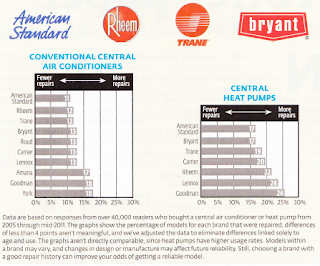
Consumer Reports Magazine surveyed more than 40,000 people who bought central AC systems. They report that American Standard is the most reliable brand and required the fewest repairs. Followed by Rheem and Trane.

Consumer Reports recommended giving the cold shoulder to Amana, Goodman and York.

Los Angeles American Standard Dealer : Kilowatt Air Conditioning

Sunday, April 15, 2012

How Air Conditioning Works


If you live in Los Angeles Air Conditioning is a MUST have. But did you ever wonder how your AC is cooling your home? What exactly does that box on the side of your house do? The above video explains in 1 minute what how air conditioning works.